Introduction
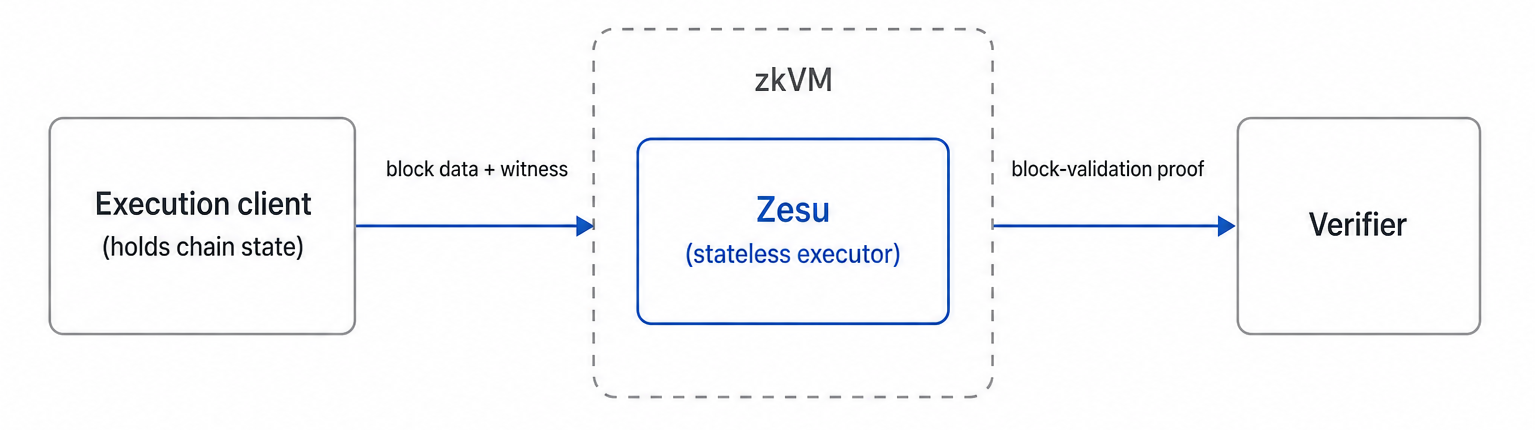
Zesu is a standalone stateless execution client, written in Zig, that generates block-validation proofs for EVM-compatible chains. Run inside a zero-knowledge virtual machine (zkVM), it re-executes blocks without holding local chain state and produces proofs that verifiers can check to confirm correct block execution without re-processing any transactions.
Why Zesu exists
Re-executing every transaction in a block is computationally expensive. Block-validation proofs offer an alternative: a verifier can confirm correct block execution by checking a compact cryptographic proof, without re-processing any transactions.
Zesu produces those proofs. The same proving capability applies to other networks that require EVM execution proofs.
How Zesu works
Zesu retrieves block data and an execution witness from an execution client that holds the full chain state, then re-executes the block inside a zkVM which produces a proof that the execution was correct.
See Architecture for how Zesu fits into the broader pipeline, and Witness retrieval for how Zesu obtains the data it needs.
Use cases
-
Ethereum L1 zkEVM proving: Provers run Zesu to prove Ethereum mainnet block execution. Provers are a distinct role in the network, separate from validators and block builders.
-
L2 rollups: L2 networks that require EVM execution proofs can use Zesu as their stateless execution client inside a zkVM.
-
Private and consortium networks: Private EVM networks can use Zesu to produce execution proofs for lightweight validators, without requiring every participant to hold or re-process full chain state.